

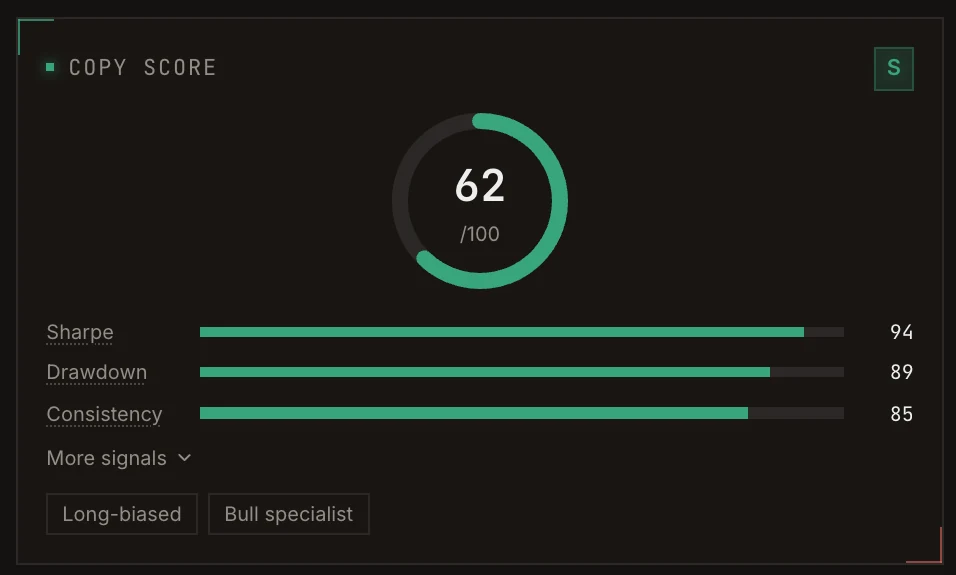
The Copy Score on a profile. A 62 is S tier here: tiers are percentiles, so the top 1% can score in the 60s.
Tiers
Tiers are percentiles of all scored wallets on the venue.What goes into it
The score is computed over the last 90 days of trading.
It is then adjusted:
- Liquidations lower the score.
- Thin history pulls the score toward 50, so a lucky streak cannot reach the top tier.
- Very high trading frequency lowers it: a wallet that trades every few seconds is hard to mirror.
- Uneven position sizes lower it: sizing that jumps around is hard to copy in proportion.
Who gets a score
A wallet needs at least 20 trades across at least 10 active days, and a trade in the last 7 days. Wallets that do not qualify show Insufficient copy history.Bias and Edge
Two tags describe style rather than quality:- Bias is the directional lean: how often the wallet is long versus short (Long-only, Long-biased, Balanced, Short-biased, Short-only).
- Edge is which side the wallet actually makes money on: Bull specialist, Bear specialist or Two-sided.